
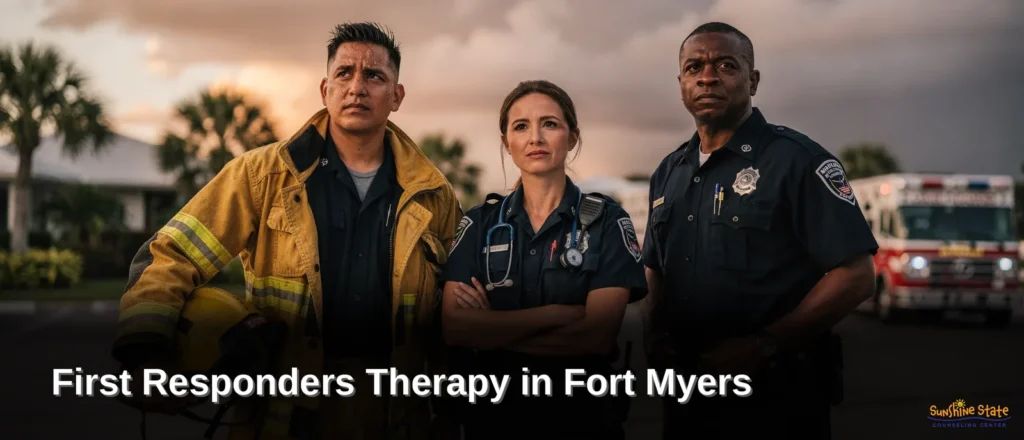
First responders in Fort Myers, including police officers, firefighters, paramedics, dispatchers, and corrections officers, face higher rates of depression, anxiety, PTSD, and substance use than the general public. Sunshine State Counseling Center provides confidential, trauma-informed counseling using EMDR and evidence-based methods, offering a nonjudgmental space where first responders and their families process job-related stress and rebuild long-term well-being.
Key Takeaways
- First responders experience depression, anxiety, and PTSD at higher rates than the general population.
- Sunshine State Counseling Center employs 17 staff members serving Fort Myers first responders.
- Certified First Responder Counselors provide specialized EMDR training and military counseling in Fort Myers.
- Southwest Florida First Responder Mental Health Symposium convened November 11, 2024 from 9AM–1PM.
Why Do Fort Myers First Responders Need Specialized Care?
Police officers, firefighters, paramedics, dispatchers, and corrections officers face trauma exposure that far exceeds what most residents encounter in a lifetime. Repeated exposure to crisis scenes, violent events, and emergency calls builds a cumulative toll that generic counseling often fails to address. Fort Myers first responders need clinicians trained specifically in trauma response, not a one-size-fits-all approach borrowed from unrelated fields.
Sunshine State Counseling Center operates locally in Fort Myers, Florida, placing first responders therapy within reach of Lee County crews without requiring travel outside the community. Local access matters when shift schedules leave little room for long commutes between calls.
Why is trauma exposure higher for first responders?
First responders serve the public every single day, often as the first people to arrive at disasters, violent incidents, and medical emergencies. That role places them at the front line of human suffering repeatedly, which drives disproportionately high rates of stress-related and trauma-related mental health effects compared to the general population.
What kind of support helps firefighters and paramedics specifically?
A therapist for firefighters or paramedics needs tools built for high-stress, high-exposure careers rather than standard talk therapy alone. Sunshine State Counseling Center provides a range of services in Fort Myers built for this purpose, including:
- Personalized Mental Health Support Through Individual Therapy for processing incident-related stress
- EMDR (Eye Movement Desensitization and Reprocessing) for trauma resolution
- Family therapy to rebuild connection strained by shift work and hypervigilance
This combination gives Lee County crews genuine emergency worker counseling support, addressing both the individual and the household affected by the job.
How Common Are Mental Health Struggles Among First Responders?
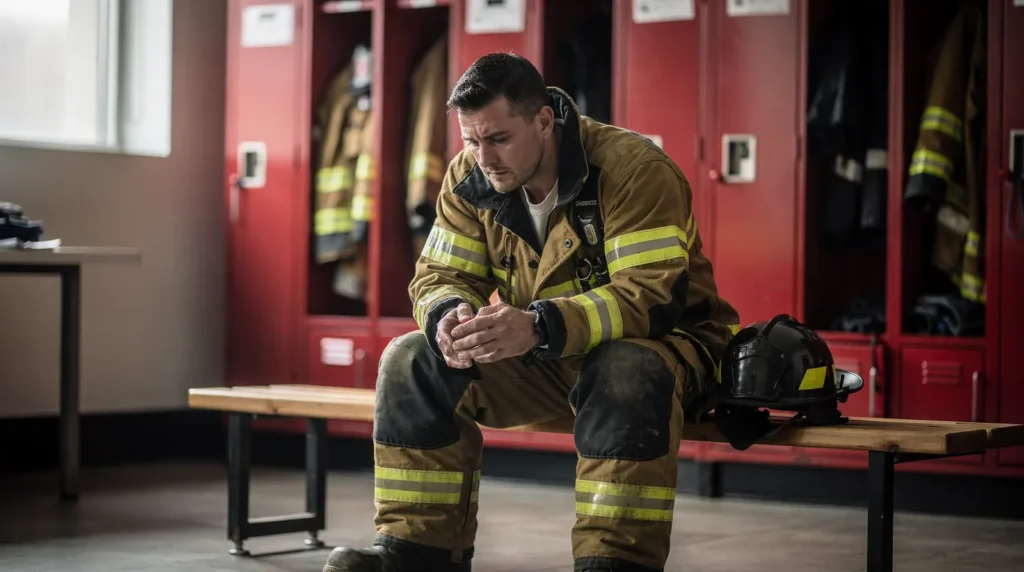
Police officers, firefighters, paramedics, dispatchers, and corrections officers in Fort Myers face elevated rates of depression, anxiety, PTSD, and problematic substance use compared with the general public. These conditions cross every specialization within emergency services. No single role escapes the risk.
Constant exposure to high-stress calls creates the foundation for this disparity. Fort Myers first responders operate in a continuous state of alertness, scanning for danger even during routine shifts. Repeated exposure to trauma, layered over years of service, compounds the strain on the nervous system. We recognize that this occupational reality, not personal weakness, drives the elevated risk our clients describe in session.
Why do first responders experience more trauma-related symptoms?
Sustained hypervigilance rewires how the brain processes threat, leaving little room for recovery between calls. A firefighter responding to back-to-back emergencies rarely has time to process one incident before the next begins. Dispatchers face a parallel burden, absorbing crisis after crisis by phone without the closure that comes from seeing an outcome. Corrections officers, meanwhile, manage daily exposure to volatility within a controlled but high-risk environment.
We treat these effects through first responders therapy designed around the operational realities of emergency work. Our clinicians serve as a therapist for firefighters, police, and paramedics throughout Fort Myers, using approaches suited to careers built on crisis response.
What treatment methods address first responder trauma specifically?
Eye Movement Desensitization and Reprocessing (EMDR) stands out as a clinically recognized modality for PTSD, anxiety, and depression. EMDR helps restore emotional balance without requiring extensive verbal processing of painful events, an approach many first responders find more accessible than traditional talk therapy alone.
- Addresses trauma symptoms tied to repeated critical-incident exposure
- Supports anxiety and depression linked to shift work and hypervigilance
- Complements broader emergency worker counseling support across Fort Myers and Lee County

What Does First Responders Therapy Actually Involve?
First responders therapy combines evidence-based trauma treatment with practical coping strategies built for the demands of police work, firefighting, paramedicine, dispatch, and corrections. We design each Fort Myers treatment plan around the specific stressors of the job, not a generic template. Overwhelmed officers, exhausted medics, and dispatchers carrying years of unprocessed calls all need a starting point that feels immediately relevant.
Sessions typically open with an assessment of current stress levels, sleep, relationships, and coping patterns. From there, our Fort Myers clinicians introduce structured techniques rather than vague advice to “relax.” Two approaches anchor most of our work with this population:
- Cognitive and relationship-focused counseling that addresses overwhelm, relationship strain, and daily stress management.
- EMDR therapy (Eye Movement Desensitization and Reprocessing), an evidence-based method that helps process past trauma, anxiety, and emotional distress, moving clients toward genuine healing rather than temporary relief.
Why Is Trauma So Hard to Treat on Your Own?
Trauma recovery proves difficult because the brain itself becomes an obstacle to healing. Unprocessed memories from difficult calls or violent scenes get stored in ways that keep triggering distress long after the event ends. Self-management alone rarely resolves this; it takes structured intervention to help the brain reprocess those memories safely.
Does Emergency Worker Counseling Support Require Specialized Training?
Effective emergency worker counseling support benefits from clinicians who understand first responder culture specifically. Some Fort Myers-area providers hold formal certification as first responder counselors, paired with EMDR training. That combination matters: a therapist for firefighters or officers needs both trauma expertise and genuine familiarity with shift work, chain of command, and the code of silence many first responders carry into the therapy room.
How Can EMDR Help Firefighters Process Trauma?
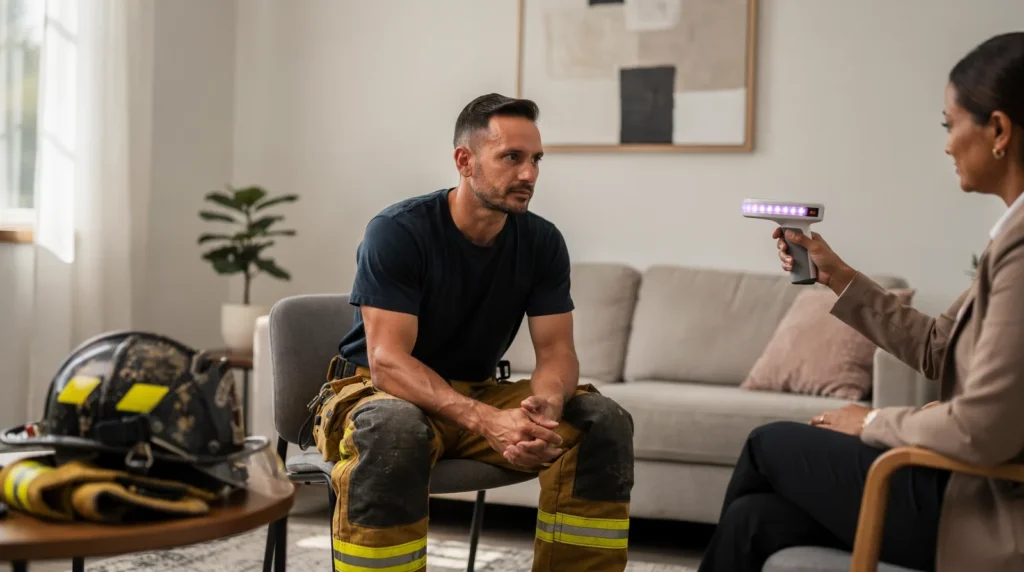
Eye Movement Desensitization and Reprocessing (EMDR) gives firefighters a structured path to release memories that talk therapy alone often cannot touch. Sunshine State Counseling Center delivers first responders therapy in Fort Myers built on this evidence-based method, helping the brain process and release deeply stored traumatic memories rather than let them fester.
Firefighters carry images most people never see: collapsed structures, fatal accidents, lives lost despite every effort. When those memories go unprocessed, the brain gets stuck on the event itself, replaying it long after the call ends. That stalling point is neurological, not a matter of willpower. Without structured, evidence-based intervention, it does not resolve on its own. No matter how much a firefighter tries to push through it.
Why does trauma linger even after years on the job?
Repeated exposure without processing compounds over time, layering one unresolved call on top of another. Fort Myers firefighters who delay treatment risk prolonged suffering, strained marriages, and distance from children who no longer understand a parent’s silence. We view early intervention as protective, not optional.
What does EMDR treatment involve for a firefighter?
Sessions guide the brain through targeted reprocessing. A specific memory loses its emotional charge without requiring firefighters to relive every detail aloud. Our clinicians pair this therapist for firefighters approach with value-based, wellness-focused goal setting, helping first responders make meaningful life changes that honor their service rather than erase it.
Our approach to emergency worker counseling support typically includes:
- Structured EMDR sessions targeting specific traumatic memories
- Goal setting rooted in personal values and long-term wellness
- A confidential space designed for the realities of shift work and crisis exposure
- Coordination with family members affected by a firefighter’s symptoms
We treat trauma recovery as active work, not passive waiting. Firefighters who start EMDR sooner give the brain a real chance to file those memories away instead of reliving them on every call.
Why Does First Responder Stress Affect Family Life?
Chronic occupational stress reshapes daily routines for police officers, firefighters, and paramedics throughout Fort Myers, and family time functions differently as a result. A shift that ends at midnight does not simply end. It lingers, often producing a preference for staying home over attending a birthday party or neighborhood gathering. Spouses and children notice the pattern before they understand it.
Loved ones frequently cannot explain the silence that follows a hard shift. They ask why a parent skips a school event or seems distant at dinner, and the answer rarely comes easily. Without context, family members may misread withdrawal as disinterest rather than a nervous system still on alert. We work with Fort Myers families to name that gap and close it through structured, confidential sessions.
Can Children Sense a Parent's Work Stress?
Children absorb tension even when no one explains its source. A firefighter’s irritability or a dispatcher’s fatigue registers in a household long before a child can articulate what changed.
**Children’s therapy** addresses this directly. Our clinicians in Fort Myers use counseling designed to help kids express emotions. Build coping skills in ways that feel natural, rather than forced or clinical.
What Therapy Options Exist for a First Responder's Child?
Younger children often struggle to talk about a parent’s stress directly. Play therapy offers guided activities that let a child process experiences. Work through difficult feelings without needing the vocabulary for them.
- Guided play sessions that build emotional regulation
- Structured activities addressing anxiety or behavioral shifts at home
- Support for children processing an emergency worker’s unpredictable schedule
Family stability starts with understanding, and understanding starts with the right support for every member of the household.
What Local Resources Support Fort Myers First Responders?
Fort Myers offers growing community support for police officers, firefighters, paramedics, dispatchers, and corrections officers seeking mental health care. The Hanley Foundation brought a Southwest Florida First Responder Mental Health Symposium to Fort Myers, giving first responders and their families a dedicated space to learn about trauma recovery. Sunshine State Counseling Center stands alongside these community efforts, offering first responders therapy to families throughout Lee County.
What happens at a first responder mental health symposium?
These trainings examine how individual experiences and department-wide culture shape mental health outcomes. Presenters address the constant alertness and repeated trauma exposure unique to emergency work. A core goal involves dispelling myths that keep first responders from seeking help, replacing silence with practical paths toward healing and growth.
Where can Fort Myers first responders find ongoing counseling support?
Symposiums build awareness, but sustained recovery requires consistent, confidential care. Our clinical team provides emergency worker counseling support designed around irregular shift schedules. The guarded communication style many first responders develop over years of service. We also serve as a therapist for firefighters navigating cumulative trauma, sleep disruption, and strain on family relationships.
Fort Myers first responders and their families benefit from several layers of support:
- Community education events, such as the Hanley Foundation symposium, that normalize conversations about first responder mental health
- Clinical counseling addressing trauma, anxiety, and relationship strain tied to emergency work
- Family-inclusive sessions that help spouses and children understand what their first responder is experiencing
Sunshine State Counseling Center supports this network with 17 employees serving Southwest Florida, including families connected to first responder work in Fort Myers. Community trainings raise awareness once a year; ongoing clinical care meets first responders where they are, week after week. Together, these resources give Fort Myers first responders more than a single symposium date. They offer a sustained path toward healing.
What Should Emergency Worker Counseling Support Include?
Effective emergency worker counseling support requires clinicians who treat first responders as their primary focus, not an occasional caseload. Our Fort Myers team works exclusively with police officers, firefighters, paramedics, dispatchers, and corrections officers, and that specialization produces measurably different results than general mental health care. Trauma exposure carries its own patterns, and treatment needs to reflect that reality directly.
Left untreated, trauma does not fade quietly. Unaddressed trauma produces psychological distress that continues long after the triggering call, shift, or incident has ended. Sleep disruption, hypervigilance, and strained relationships often persist for months or years without targeted intervention.
Does counseling support extend to first responder families?
Yes. Spouses and children of Fort Myers first responders carry their own version of the stress, often without recognition or resources. We offer therapist for firefighters’ families. Other emergency personnel, including counseling designed specifically for children coping with a parent’s demanding, high-risk work.
For younger family members, we use play therapy and sand tray therapy. These approaches help children process emotions, build confidence, and work through challenges within a safe, structured setting.
What makes a therapist the right fit for first responders?
Fit matters as much as credentials. Relationships often begin shifting only after a first responder finds a clinician who genuinely understands the job’s demands and its toll.
Comprehensive first responders therapy in Fort Myers should include:
- Clinicians experienced specifically with first responder populations
- Trauma-focused modalities addressing symptoms that standard talk therapy overlooks
- Family and child services for spouses and children affected by the work
- Confidential, judgment-free scheduling that accommodates rotating shifts
Sunshine State Counseling Center structures every intake around these standards, ensuring Fort Myers first responders and their families receive care built for their specific reality.
How Do You Start Care in Fort Myers?
Starting care begins with a single call or online inquiry to a Fort Myers office equipped to serve first responders. Sunshine State Counseling Center’s Fort Myers location gives local police officers, firefighters, paramedics, dispatchers, and corrections officers a nearby, accessible starting point for first responders therapy. Waiting rarely makes symptoms easier to manage. Mental health challenges compound over time, growing harder to treat the longer a first responder delays reaching out for support.
Delayed care often means treating multiple overlapping problems instead of one manageable issue. What begins as trouble sleeping can widen into strained relationships, irritability on shift, or withdrawal from family. Early contact with a Fort Myers-based provider interrupts that pattern before it deepens.
What happens during the first steps of care?
Intake typically starts with a conversation about current stressors, work history, and specific goals for treatment. A therapist for firefighters, paramedics, or dispatchers uses that information to tailor a plan rather than apply a one-size-fits-all approach. Clinicians recognize that the brain naturally processes and integrates experience, but repeated exposure to traumatic calls can overwhelm that system. Treatment planning accounts for that disruption from the first session.
Is individual therapy the only option?
No. Fort Myers first responders benefit from multiple formats of emergency worker counseling support, including:
- Individual sessions focused on trauma processing and coping skills
- Family-inclusive sessions addressing strain at home
- Peer-informed group settings connecting first responders with others who share the same demands
Peer-informed groups exist specifically to demonstrate that a balanced life remains possible while still performing the job. Hearing that message from another firefighter or officer carries weight that generic advice cannot match. Fort Myers first responders considering care start with a conversation, not a commitment, and that first conversation opens every option that follows.
FAQ
Why do Fort Myers first responders need specialized mental health care?
Repeated exposure to crisis scenes and violent events builds a cumulative trauma toll that generic counseling fails to address. Sunshine State Counseling Center provides trauma-informed, local care in Fort Myers built specifically for this population.
What services does Sunshine State Counseling Center offer first responders?
Services include individual therapy for incident-related stress, EMDR for trauma resolution, and family therapy to rebuild connection strained by shift work and hypervigilance. This combination addresses both the individual and their household.
Where is Sunshine State Counseling Center located?
Sunshine State Counseling Center operates locally in Fort Myers, Florida, with 17 staff members serving the area’s first responders. This local presence removes the need for travel outside the community.
Facts
- Sunshine State Counseling Center is located in Fort Myers, Florida, US.
- Sunshine State Counseling Center has 17 employees.