
Teen therapy groups in Fort Myers give adolescents structured peer support alongside licensed clinical guidance. We lead groups such as “Smart but Scattered,” a closed, weekly ADHD and executive-functioning group grounded in research by Dr. Richard Guare and Dr. Peg Dawson, addressing planning, procrastination, attention, emotion regulation, and social media management.
Key Takeaways
- Sunshine State Counseling Center offers “Smart but Scattered,” an ADHD group for teens led by licensed school psychologists.
- The ADHD/Executive Functioning group addresses planning, organization, procrastination, and attention through weekly sessions during select seasons.
- Adolescent group therapy helps teens recognize they’re not alone during challenging independence and relationship-building years.
- Sunshine State Counseling Center employs 17 staff members providing peer support and therapeutic services in Fort Myers, Florida.
Why Do So Many Fort Myers Teens Feel Alone?
Isolation during adolescence stems from a collision of forces: growing independence, shifting friendships, and the pressure to maintain family bonds all at once. Many teens across Fort Myers describe feeling disconnected even while surrounded by classmates and family. These pressures rarely announce themselves loudly; instead, they build quietly through missed conversations and unspoken worry.
We see this pattern often in our work with local families. As adolescents pull toward independence, they simultaneously try to build new peer connections while holding onto relationships with parents and siblings. That balancing act can overwhelm even resilient kids, leading to withdrawal, irritability, or excessive screen time as coping mechanisms.
What Are the Signs a Teen Feels Isolated?
Watch for changes in mood, sleep, or social habits that persist for more than two weeks. A teen who once enjoyed friends but now avoids gatherings. Who seems anxious about school without explanation, may be signaling deeper loneliness. These shifts often prompt Fort Myers parents to seek structured support before the pattern deepens.
Structured peer settings offer one proven path forward. Teen therapy groups give adolescents a space to hear from others facing similar struggles, which directly counters the belief that they are the only ones struggling. Recognizing shared experience reduces shame and opens the door to healthier coping strategies.
We provide adolescent group therapy in Fort Myers designed around this principle: connection reduces isolation. Local families benefit from peer support groups for teens that meet close to home, removing the added burden of long travel for already-stretched schedules. Because Sunshine State Counseling Center operates directly in Fort Myers, Florida, families throughout the area can access this kind of support without unnecessary delay.
What Exactly Are Teen Therapy Groups?
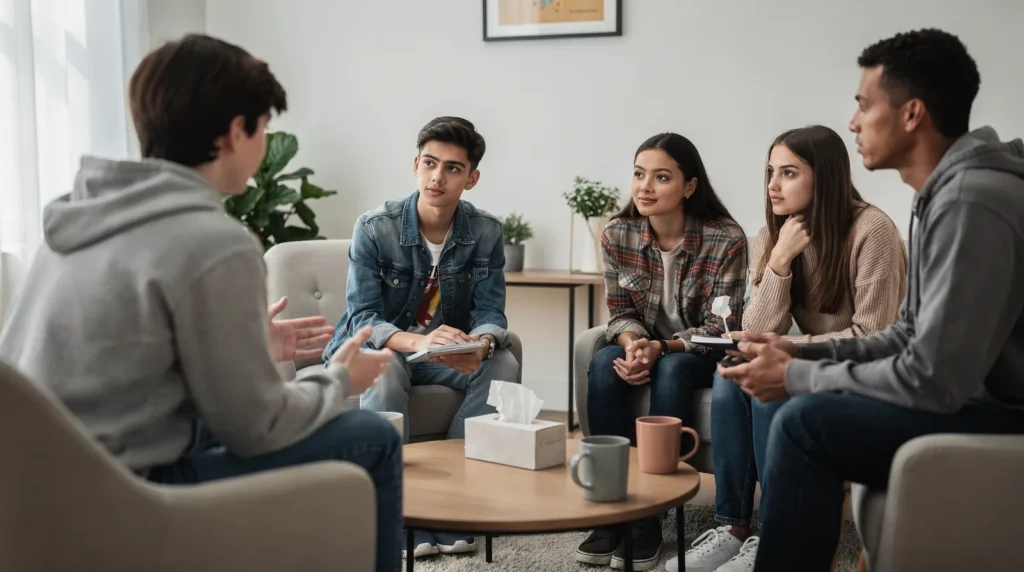
Teen therapy groups bring adolescents together with a licensed clinician to work through shared struggles in a structured, guided setting. Isolation often deepens a teenager’s anxiety or grief; a group format directly counters that isolation by putting peers in the room together. We treat this format as an extension of the individual counseling we already provide to young clients across Fort Myers.
Our approach to adolescent group therapy Fort Myers families rely on mirrors our broader philosophy for children’s counseling: help young people express emotions and build coping skills in ways that feel natural to them, rather than forced. We draw on art therapy, sand tray therapy, play therapy, and traditional talk counseling to create a setting where teens feel supported rather than examined. For younger participants within these programs, guided play still plays a role, helping them process experience and build problem-solving skills through activity instead of interrogation.
How is a therapy group different from individual counseling?
A group setting introduces peer reflection that one-on-one sessions cannot replicate. Teens hear from others facing similar pressures, which normalizes their experience and reduces shame. Individual counseling remains the right starting point for many families. Groups add a social dimension that reinforces skills learned in private sessions.
How many teens are typically in one group?
Effective peer support groups teens attend maintain a limited enrollment, ensuring each member has space to speak and be heard. Smaller rosters protect the trust that makes group work effective. We structure our own groups with that same principle: enough voices for connection, few enough for genuine listening.

How Does Adolescent Group Therapy Work Here?
Structured, weekly group sessions form the backbone of our approach for Fort Myers teens. A licensed school psychologist leads our “Smart but Scattered” group, one of our teen therapy groups designed around executive functioning research from Dr. Richard Guare and Dr. Peg Dawson. Rather than a loosely organized meetup, this program follows a curriculum built for adolescents who struggle with planning, focus, and follow-through.
The group operates on a closed enrollment model, meaning membership stays fixed once a session begins. Weekly meetings occur during select seasons throughout the year, giving families a predictable rhythm to plan around. This closed structure allows teens to build trust with the same peers session after session, which strengthens the adolescent group therapy fort myers families rely on for consistency.
What topics do sessions cover?
Each session targets a specific executive functioning challenge. Topics include:
- Planning and organization strategies
- Techniques for avoiding procrastination
- Attention and focus improvement
- Emotion regulation skills
- Managing electronics and social media time
These areas reflect the daily friction points many teens face at home and school.
Who leads these groups, and why does that matter?
A licensed school psychologist facilitates the ADHD and executive functioning group, bringing clinical training specific to adolescent development. That expertise sits within our broader team of 17 employees, who collectively support multiple clinical approaches for young clients. Families gain access to peer support groups teens can lean on alongside individualized care, without needing to coordinate separate providers.
We built this model so teens are not just attending sessions, but practicing skills in real time with peers who understand their struggles. Consistency, clinical leadership, and clearly defined topics keep the process grounded and purposeful.
What Peer Support Options Exist Locally?
Fort Myers families have access to several community-based options beyond individual counseling. Community organizations have run free, in-person groups for LGBTQ+ teens ages 14 to 17, meeting on weekday evenings across a multi-month season. These sessions used an expressive arts format, giving participants creative tools rather than a strictly talk-based structure. We view options like these as valuable complements to clinical care, especially for teens who benefit from peer support groups teens alongside individual sessions.
What happens in an expressive arts teen group?
Expressive arts sessions guide teens through identity exploration, self-esteem building, and honest conversations about asking for help. Activities have touched on themes such as personal pride, the masks people wear to hide struggles, and finding one’s voice within a group. This format works well for adolescents who find traditional talk therapy intimidating. Creative expression often surfaces feelings that words alone cannot capture.
Do local teen groups cost money?
Cost varies by program, and some community offerings have been provided at no charge, including materials, with advance registration required. Free access matters for families weighing multiple support options at once. We encourage parents to ask directly about fees, registration windows, and eligibility before enrolling a teen.
Beyond Fort Myers, structured adolescent group therapy fort myers families may consider includes broader Florida-based programs. Some treatment programs across the state connect teens ages 13 to 18 in small, safe settings built for shared healing, with group sizes kept intentionally limited. Smaller groups allow more room for each teen to be heard.
Comparing formats helps families choose wisely:
| Format | Age Range | Cost | Focus |
|---|---|---|---|
| Community expressive arts group | 14–17 | Often free | Identity, self-esteem, expression |
| Statewide adolescent program | 13–18 | Varies | Structured healing, small cohorts |
Teen therapy groups work best when matched to a teen’s comfort level, schedule, and specific needs.
Which Teen Struggles Do These Groups Address?
Anxiety, behavioral outbursts, difficulty naming emotions, and academic struggles rank among the clearest signals that a teenager needs structured peer support. Major life changes—divorce, relocation, loss of a friendship—often trigger these same warning signs. Sunshine State Counseling Center designs our teen therapy groups around these exact struggles, giving Fort Myers families a setting where adolescents recognize they aren’t alone.
Trauma adds another layer of complexity. Unprocessed traumatic memories leave the brain fixed on past events, producing distress that outlasts the original experience by months or years. We apply EMDR (Eye Movement Desensitization and Reprocessing) within our adolescent group therapy in Fort Myers to address PTSD, anxiety, and depression, restoring emotional balance through structured, compassionate care rather than open-ended conversation alone.
What issues do peer support groups for teens typically cover?
Grief, family transitions such as divorce, and social difficulties appear consistently among the concerns that respond well to group settings. ADHD-related struggles with focus and self-regulation also surface often. Depression frequently accompanies these challenges, making a shared support structure more effective than isolated treatment.
Common struggles and how group-based care responds:
- Anxiety and mood struggles: shared coping strategies reduce isolation
- Behavioral issues: peer accountability reinforces healthier patterns
- Trauma and PTSD: EMDR-informed techniques target stuck memories
- Family disruption (divorce, loss): group dialog normalizes the experience
- School difficulty: peers facing similar academic stress offer perspective
Can group therapy help a teen who struggles to talk about feelings?
Teens who struggle to express emotions in individual settings often open up more readily among peers facing similar circumstances. Peer support groups for teens ease the pressure of one-on-one disclosure while still building emotional vocabulary. Over time, this shared environment strengthens the coping skills each teen carries into daily life at home and school.
How Does EMDR Support Group-Based Trauma Care?
Guided eye movements form the core of EMDR, a structured method that helps teens process traumatic memories rather than avoid them. We use this approach as a complement to group work, giving Fort Myers adolescents a private space to address the roots of pain that group sessions alone cannot fully reach. Teen therapy groups offer connection and shared understanding; EMDR offers a targeted path to resolving the memory itself.
We rely on this pairing because trauma left unaddressed does not stay contained. Fort Myers families who postpone trauma-focused treatment for their teens risk watching suffering stretch on, relationships fracture, and mental health struggles compound over time. A teen managing untreated trauma often withdraws from peers, struggles academically, and finds it harder to trust others in exactly the settings — like peer support groups teens rely on — where healing could otherwise take hold.
Why Combine EMDR With Group Therapy for Teens?
Group settings build belonging; EMDR builds resolution. Teens gain the reassurance that comes from adolescent group therapy fort myers offers, hearing peers voice similar struggles. EMDR gives them a dedicated space to work through the specific event driving their distress.
Is EMDR Effective for PTSD in Teens?
EMDR has earned recognition specifically for treating post-traumatic stress disorder, making it a fitting option for teens carrying diagnosable trauma symptoms. Effectiveness here is well documented, not experimental.
How EMDR and group care work together:
- Group sessions provide peer validation and reduce isolation.
- EMDR sessions target specific traumatic memories individually.
- Combined care addresses both social and psychological dimensions of recovery.
Access to EMDR continues expanding across the Fort Myers area, giving families a growing resource rather than a limited one. We view this availability as essential groundwork for lasting recovery, not a temporary offering.
What Should Parents Look For In A Group?
Qualified leadership matters most. We look for a trained therapist guiding every session, building emotional regulation, social skills, and coping strategies among participants rather than leaving teens to navigate discussions unsupervised. Structure and clinical oversight separate a genuine therapeutic group from an informal gathering. Fort Myers families deserve that distinction when choosing a program.
Age-appropriate methods count too. Traditional teen therapy groups rely on different techniques than younger children’s programs; play-based approaches typically serve ages 3 to 12. Certain adapted play techniques still benefit older adolescents working through difficult emotions. A strong program adjusts its methods to match developmental stage, not just chronological age.
What makes adolescent group therapy in Fort Myers effective?
Personalization drives results. We build sessions around each teen’s individual personality, specific challenges, and personal goals instead of applying one rigid curriculum to every participant. A group addressing social anxiety, for instance, requires a different rhythm than one focused on grief or family conflict.
How do parents secure a spot in local peer support groups?
Registration windows close quickly for community-based peer support groups teens often rely on in Fort Myers. Free programs, in particular, frequently require advance sign-up to confirm attendance before sessions begin. Parents should ask early about enrollment deadlines rather than assuming space will remain available.
Before enrolling a teen, we recommend reviewing:
- Clinical oversight: Is a licensed or trained therapist facilitating every session?
- Age fit: Do the methods match the teen’s developmental stage?
- Individualized planning: Does the group adjust to each participant’s goals?
- Enrollment logistics: What registration deadlines or requirements apply?
These four factors give parents a reliable framework for evaluating any group before committing a teen’s time and trust.
How Do You Start Teen Support Today?
Sunshine State Counseling Center welcomes Fort Myers families through its Fort Myers, Florida office. Staff coordinate intake for adolescents and parents alike. Getting a teenager connected to structured care starts with a simple call or online inquiry, followed by a scheduling conversation matched to the family’s needs. From that first contact, a team of 17 employees supports multidisciplinary, evidence-based care designed around each young client and household.
Our clinicians draw on multiple treatment approaches rather than a single template. For younger adolescents and children, we combine art therapy, sand tray therapy, play therapy, and traditional counseling to build a supportive, engaging environment where expression feels safe. Older teens facing trauma, anxiety, or depression may benefit from EMDR, a clinically recognized modality we apply to address PTSD and related symptoms while restoring emotional balance through structured, compassionate sessions.
What should we expect at the first appointment?
Expect an intake conversation focused on identifying the right fit among our teen therapy groups and individual services. Clinicians ask about school stressors, family dynamics, and any prior treatment history before recommending a path forward. No family walks in required to commit to a specific modality before that conversation happens.
How do we choose between individual and group options?
Some teens respond best to one-on-one sessions. Others gain more from adolescent group therapy fort myers families rely on to build peer connection. Our clinical team helps sort that decision case by case.
| Starting Step | What Happens |
|---|---|
| Initial contact | Family reaches the Fort Myers office to request services |
| Assessment | Clinician reviews needs and recommends individual or group care |
| Matching | Teen is placed in appropriate peer support groups teens or paired with a therapist |
| Ongoing care | Sessions continue with EMDR, play therapy, or other modalities as needed |
Every step keeps the family informed, ensuring teens receive consistent, evidence-based support without unnecessary delay.
FAQ
What is the "Smart but Scattered" group?
A closed, weekly ADHD and executive-functioning group led by licensed school psychologists, based on research by Dr. Richard Guare and Dr. Peg Dawson. It addresses planning, procrastination, attention, and emotion regulation.
How does group therapy help isolated teens?
It brings adolescents together with a licensed clinician to work through shared struggles, showing them they aren’t alone. This shared experience reduces shame and opens the door to healthier coping strategies.
Where does Sunshine State Counseling Center offer these groups?
Sunshine State Counseling Center operates directly in Fort Myers, Florida, with 17 staff members providing peer support and therapeutic services. This allows local families to access support close to home without long travel.
Facts
- Sunshine State Counseling Center is located in Fort Myers, Florida, US.
- Sunshine State Counseling Center has 17 employees.
Conclusion
In closing, teen therapy groups and peer support represent evidence-based interventions that address the developmental needs of adolescents navigating complex emotional and social challenges. Sunshine State Counseling Center integrates these modalities within a comprehensive clinical framework designed to foster meaningful connection, build coping skills, and promote lasting psychological growth. For families in the Fort Myers area seeking specialized adolescent mental health services, group-based and peer-supported approaches offer a pathway toward resilience and healthier relational patterns during a critical developmental period.